
Investor & GP voices
360° investment intelligence
See the business behind the pitch deck.
SCALEUP.report is a fixed-scope scalability 360° assessment of a growth company. It is an ultra-fast, senior-assisted Business MRI built primarily for investors evaluating, acquiring, or supporting growth companies. For founders and CEOs, it also provides an objective priority check, exposes scalability gaps, cross-checks current plans, and strengthens preparation for investor meetings and due diligence.
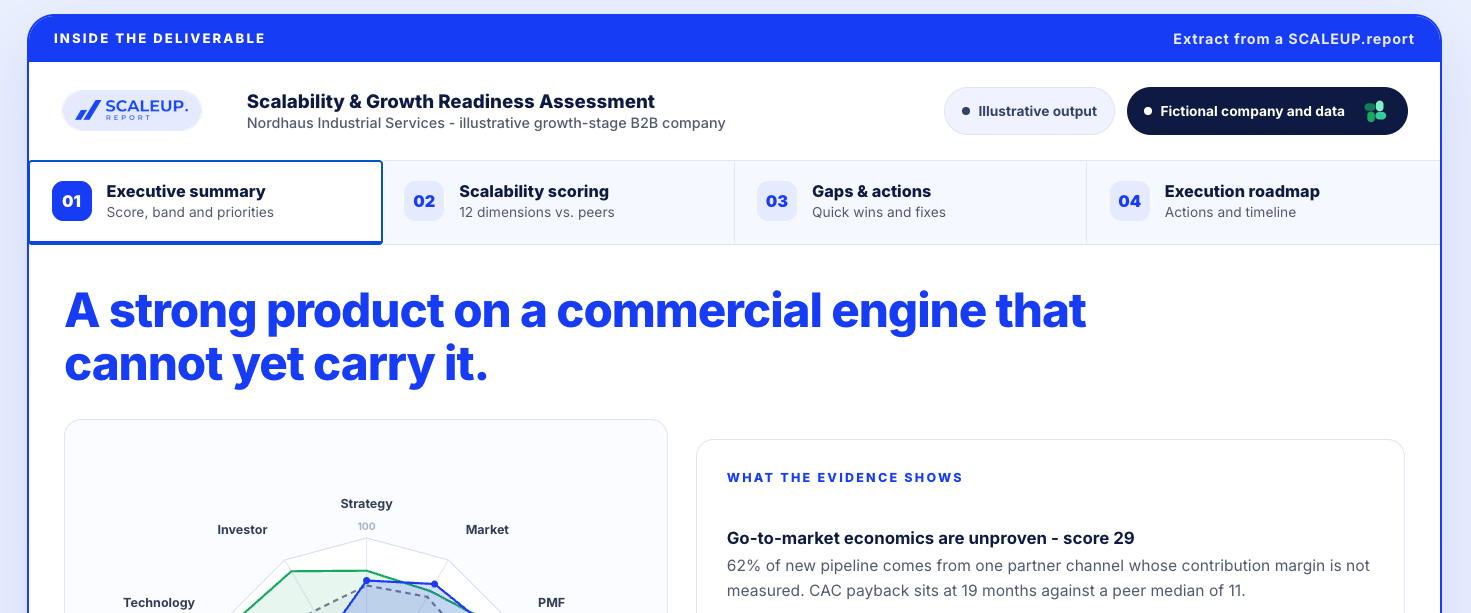
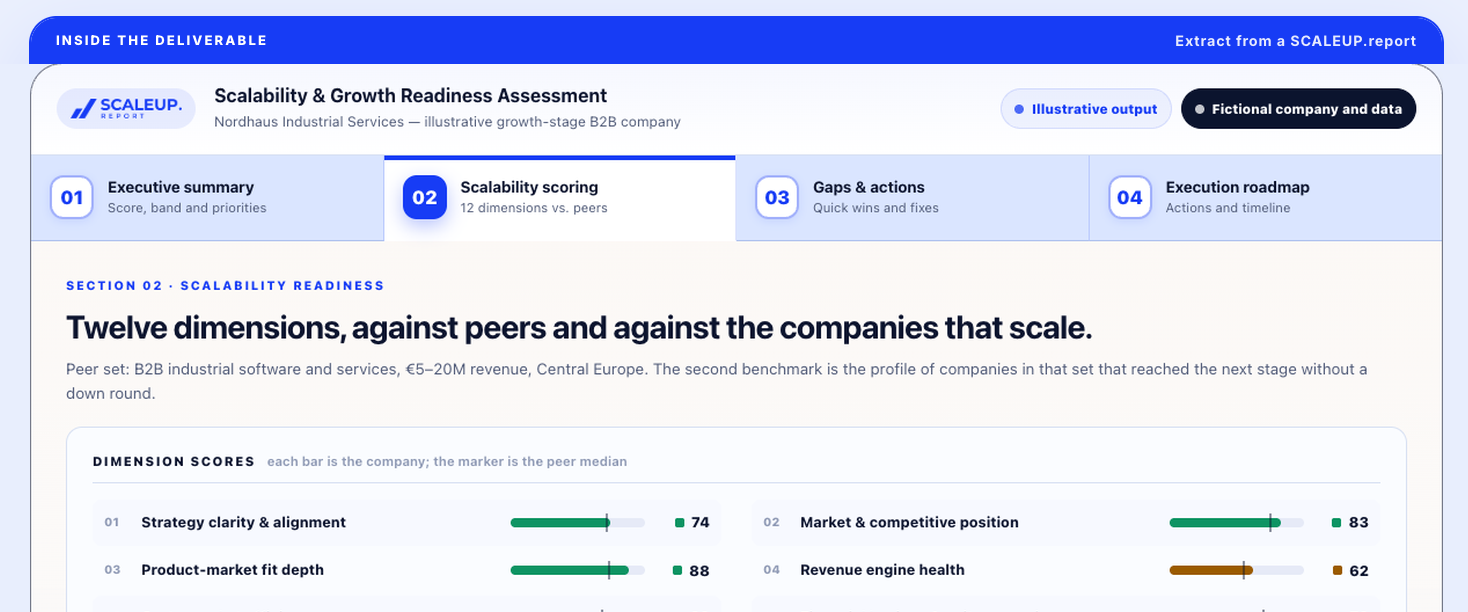
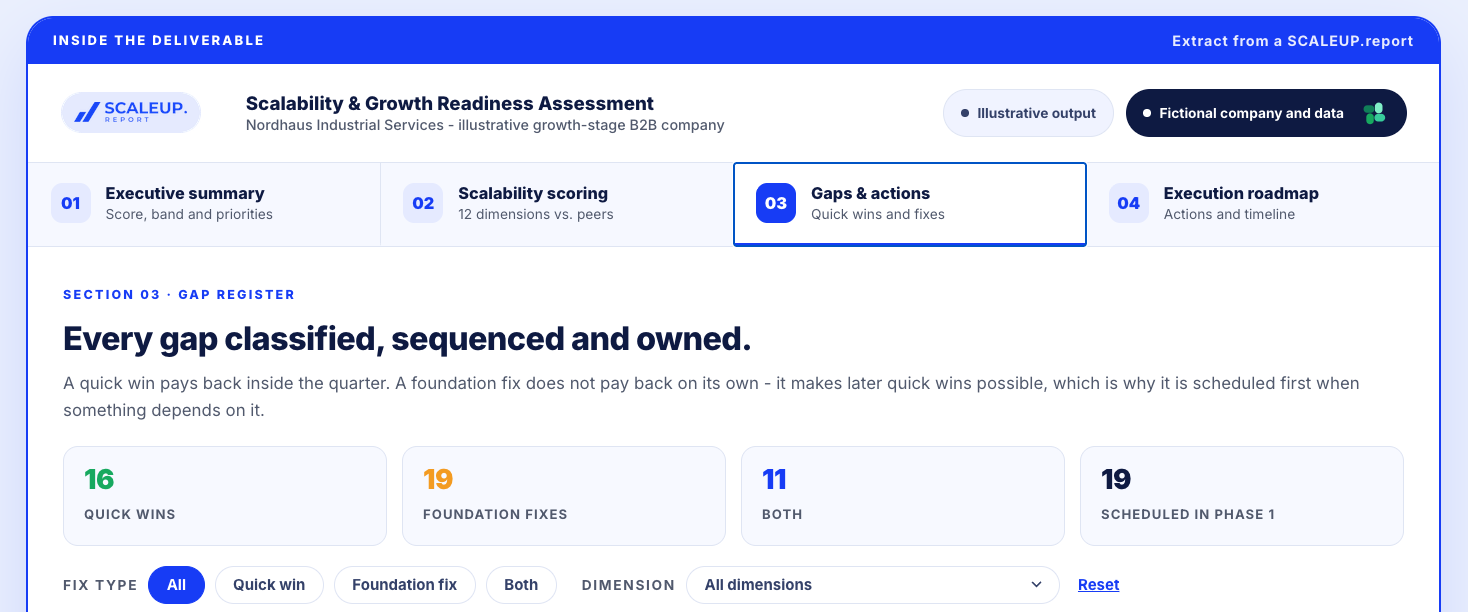
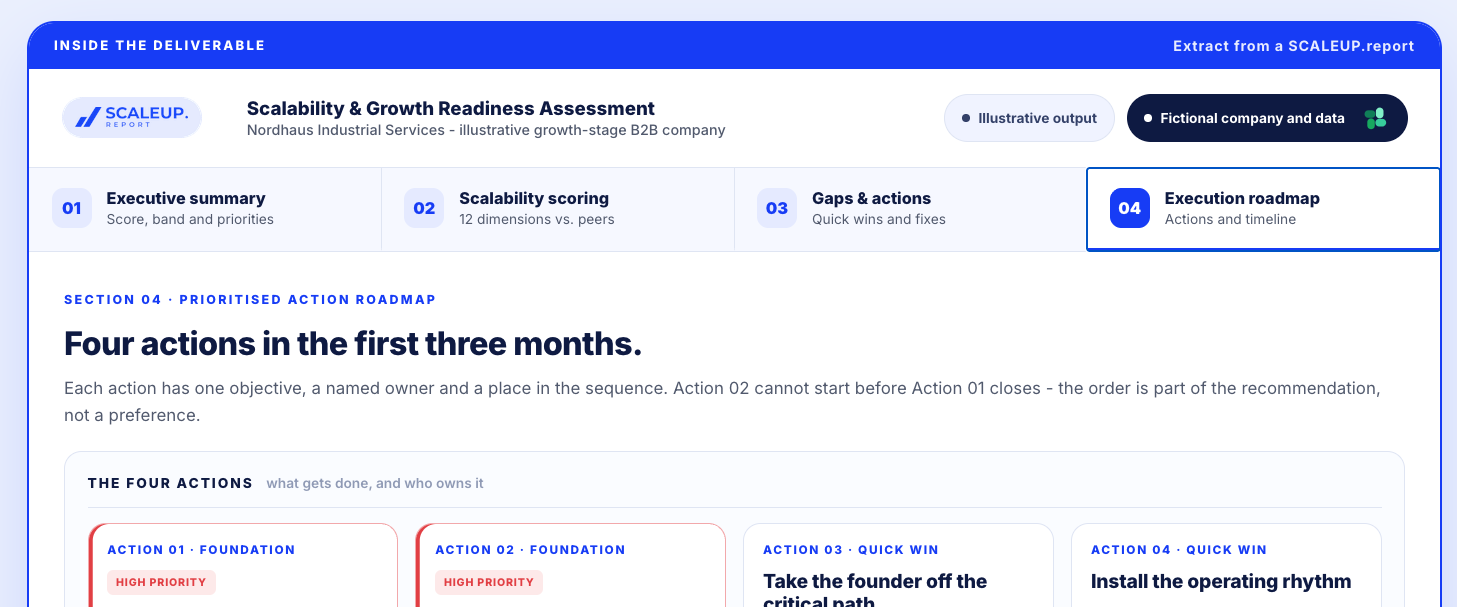
4hrs
One session, fast investment.
12
Business dimensions.
300+
Scalability levers checked
1report
One complex report. Many purposes & benefits.
Definition
What is it?
A fixed-scope commercial 360° assessment of a growth company, in three levels.
45 min.
SCALEUP.report SIGNAL
Rapid twelve-dimension triage for angels, syndicates, the early VC funnel and fundraising preparation.
240 min.SCALEUP.report FULL 360°
Senior interviews and evidence challenge, thesis and failure modes, a 90-day roadmap and a Day-0 baseline.
300 min.SCALEUP.report FULL 360° PLUS
Everything above plus a consent-based leadership and psychometric layer for founder-led investments.
Only one pillar in question? Explore Focused Assessment
FULL 360° scores all twelve dimensions. A Focused assessment runs the exact same senior-assisted process on just one, Sales, Talent, or Business Development, so scope is the only thing that changes.
See Focused pricingEvery level runs the same twelve SCALEUP.report dimensions and ends in one decision: proceed, verify, attach conditions, pause or walk away. It complements legal, financial, tax, cyber and technical due diligence rather than replacing them. Compare the levels · see the twelve dimensions.
One assessment, three value moments
Get Value on Day One
A relatively small, fixed-scope assessment can protect a much larger capital decision, help a founder enter the process better prepared, and continue creating value after the transaction closes.
ProceedVerifyAttach conditionsPauseWalk away
Investment decision support
Test the investability of the operating system.
Separate what is proven from what is merely asserted, expose the failure modes that matter, and make the remaining uncertainty actionable.
- Validate the investment thesis against commercial reality
- Prioritise confirmatory diligence and management questions
- Translate uncertainty into price, conditions, milestones, or conviction
- Reject weak opportunities faster without exhausting the deal team
Where to go next
Pick the path that matches your decision.
Every page covers one part of the assessment: who it is for, how it works, and what it costs.
Proof from both sides of the table
References
Founder & CEO voices
Make scaling with a clearer view.
Investors can scope a decision assessment. Founders and CEOs can validate priorities, plans, scalability, and investment readiness before outreach or due diligence.